
Create ‘n Facilitate
A 7-week incubator where we (re)design your group container and hone your facilitation skills so you — and your clients — have a space you’re
jazz hands excited about
Think: stronger engagement, better outcomes, easier sales
Enrollments close October 2nd

People are HUNGRY for meaningful points of connection with other human beings.
For safe spaces where they feel seen.
For the opportunity to share the ‘less than perfect’ parts of themselves, or the goals they don’t fully believe they’re ‘entitled’ to, or the gaps in their knowledge, and have someone (or a bunch of someones) say, “yeah, me too.”
To feel like they’re part of something.
It’s no secret that group spaces are having a moment right now
And the idea of your program, membership, or community being one that ticks all these boxes is firmly on your vision board—

But, at the moment, there are signs it’s not quite hitting the mark…
✘ Maybe your members bring questions to you in DMs instead of posting them in the group space, which means (a) the space looks dead, even though things are happening inside (at least for some people), and (b) you’re effectively providing 1:1 support at a 1:many rate
✘ Maybe you have a core group who shows up to your calls, but the conversation never seems to go anywhere. It’s polite, but shallow — definitely not the ‘breath of fresh air’ kind of energy you were aiming for
✘ On the other hand, maybe attendance really has dropped off, and your last zoom room had more AI notetakers than actual humans — an experience that was truly humbling
✘ Maybe you’ve stopped your ‘first-thing-in-the-morning’ checks for notifications, given it’s been a while since the chat was zinging
✘ Maybe you modeled your mastermind/membership/group program based on the online spaces you’ve been part of before, but are starting to realise 1x monthly workshop and 1x monthly Q&A aren’t ‘it’ — at least not for you, and not for your students
✘ Maybe your members tell you they love it, but churn is high, and word-of-mouth referrals never seem to materialise, which means you’ve started to wonder if they actually love you (your ideas, your presence, the stuff you do outside the container), rather than the space you’ve created
✘ Maybe you haven’t launched your space yet, but have been part of enough mediocre ones to know you want yours to be different
Whatever challenges you’re facing, the fact that you’ve:
a) noticed, and b) care, means
You already have the exceptional, unlearnable quality of giving a damn—
So how about we bolster that with the strategy, skills, and confidence required to create exceptional experience and outcomes
for the people in your online space?

Introducing…
Create ‘n Facilitate
A 7-week incubator where we (re)design your group space and hone your facilitation skills for stronger engagement, better outcomes,
and easier sales
Enrollments close October 2nd
Here’s a taste of what’s shifted
for people inside…
Because you’re way too seasoned to accept a claim like that without proof 😉

“It was so flipping fun and easy to make small changes that rippled into major differences. Increased show up rates to live calls, increased engagement in asynchronous support, more structure on live calls without stifling the life of the group… people are clamouring to participate.
I hosted a live event and felt uber confident in framing out how everyone could make the most of our time together, and it was a huge success, raising $1000 for a humanitarian organization, and it was so much easier to keep on track and organized and helpful (and fun-raise-worthy) with what I learned here.
(My confidence has) Increased a billion times… and I was pretty effing confident before.
This was truly a win-win for me. So much value that I'm sure I still haven't fathomed all the things I'm truly walking away with.”
- CAROLYN ROBISTOW, GROUP PROGRAM COACH FOR THERAPISTS

It is the small changes that make a difference. I think that was the thing that surprised me the most.
I've done a much better job of framing each call we have, and I just scheduled all of Q4's calls, which all have better framing than in the past. I have redone the Foundations AI-facilitated course, and that has been amazing. I added a little gamification to call out the places where they're going to submit for feedback and make the whole thing more interactive. I've also started using a reflection process on my hot seat calls, because usually that surfaces something. This is a small thing, but being reminded of some of the facilitation skills, like reflecting back instead of just jumping into somebody's problem, has been really good.
I'll be honest: I was a fairly confident facilitator beforehand, but now I feel like I have more skills. I know what those skills are called, and it has also reminded me of some of them and encouraged me to touch back on those.
I had a private tour, and someone asked me a very pointed facilitation question: "How do you handle it when a member is dominating a call and is the first person to always give feedback?" One of the things I was able to say to her was, "I have training in facilitation. I know how to handle those situations, and it's my job to do so." She was like, "Oh my gosh, that's so reassuring to know that you know how to facilitate, because there are so many people who have programs and don't."
- DR MICHELLE MAZUR, MESSAGING STRATEGIST, AUTHOR, TED X SPEAKER
“The Expert Up Club is better because of the work we did. I feel more confident selling it because of the work we did.

I was getting bored with the same old same old, knew it (my offer) could be improved, and just needed someone to guide me through the process.
I'm headed into a launch next week and I'm really excited about both selling and delivering it this time!
I'm not someone who buys many offers anymore. Been burned too many times in the past. 😉 I can say with all sincerity that this is the ONE offer I have zero regrets about.”
- JACQUI ACREE, EFT PRACTITIONER
“I have a space I’m jazz-hands excited about. Plus I understand the WHY underneath the decisions. Priceless.

Hi, by the way —
I’m Kirsty.
Ex-psychotherapist, ex-academic, ex-launch copywriter, and (thanks to those careers) an ex-pert at designing and facilitating epic group spaces.
I’m not saying that to toot my own horn, or because I think I’m ‘special’, or even because the semantics of that sentence make me happy (ok, ok — maybe I did get a little kick out of ‘ex-pert’)—
But as a way to illustrate, right off the bat, that my approach to group containers is a little different from what you might be used to seeing…
The AI prompts that help you ‘coursify’ your content.
The coaches that help you sell and market your offer.
The automations and strategies that help you evergreen your enrolments.
Basically, all the resources out there that assume the only way to optimise your group container is to pour more energy into the external-facing bits… rather than spending time enriching the experience for people inside it.
My approach definitely has its perks…
Starting with 10+ years of experience running online spaces that reliably get this kind of feedback
If you’re thinking, “gee, I’d love that kind of feedback about MY group spaces!” the good news is you’re closer than you think
The fact you’re on this page tells me you’re someone who gives a damn about the people in your program, and I have no doubt the ‘what’ you have on offer is exceptional.
All we need to do is work on the ‘how’—
Aka, skill you up in the craft of facilitation (which, for the record, is a very distinct skillset from your existing zone of genius, whether that’s writing copy, designing epic brands, hosting a top 10 podcast, calming overstimulated nervous systems, or whatever it is that you’re very bloody good at), and get your noggin around how to (re)design your space so it deliberately supports the people inside and — in doing so — scaffolds their path to real-world outcomes.
Here’s why I think you should choose Create ‘n Facilitate for that task…

Create ‘n Facilitate is built so that it’s damn near impossible for you to come out the other side without:
→ The ability to make informed, strategic, responsive decisions about your group space and the people in it
Think: which touchpoints to include, when to schedule them, whether to run live cohorts or rolling enrolments, how many people should be inside at any one time (and whether there should be an application process), how to leverage gamification and reward to maximise engagement, and what to do when something veers off-course (e.g. a poor-fit member taking things off the rails, or an engagement slump you didn’t plan for)
→ An onboarding process that sets your group — and the people inside it — up for success from the moment they opt-in
Something that helps your members feel excited and confident about stepping into your space, while also laying the groundwork for the rules of engagement, so you’re not starting cold or wrangling wild dynamics on day 1
→ The facilitation skills that create a genuine sense of safety, belonging, and momentum for people on the receiving end
Aka the soft skills that transform your space from something people pop into to something they’re part of — a living, breathing kind of experience.
→ The confidence to respond to group-related challenges in real time — with as little awkwardness as possible
Things like (re)igniting engagement in a quiet room, responding quickly and effectively when someone is ‘hogging the mic’, knowing how to navigate the “this isn’t the right fit” conversation, and more.
→ An offboarding process that manages to close the space — or someone’s part in it — in a meaningful way, and naturally invite ongoing relationships and future opportunities
Whether that’s an upsell, collaboration (e.g. affiliate and referral pathways), or a reliable channel to capture evolving outcomes so you can constantly feed your bank of social proof.
→ The kind of trust in and excitement about your group space that makes it very bloody easy to sell
Which is no small thing with launch season just around the corner…

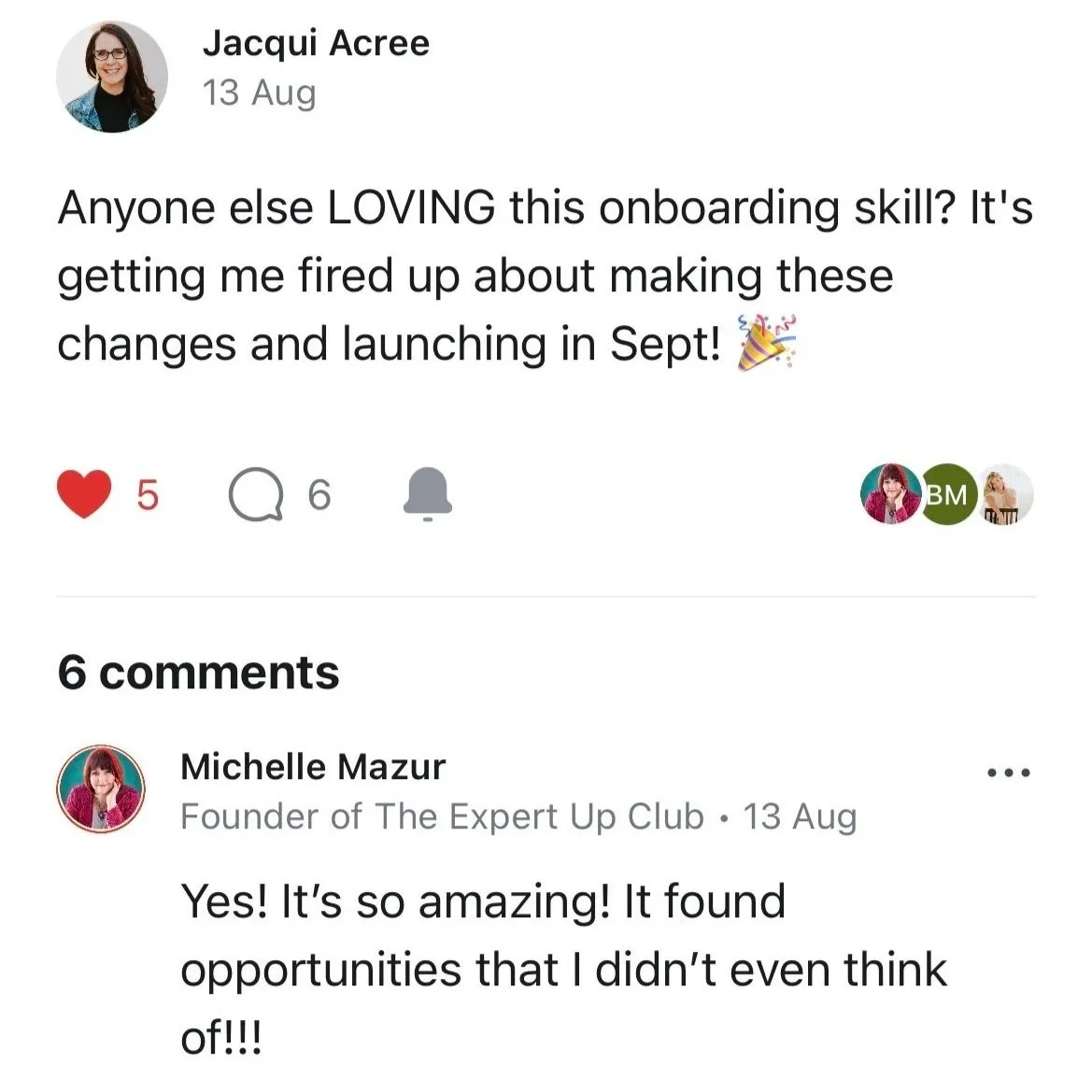
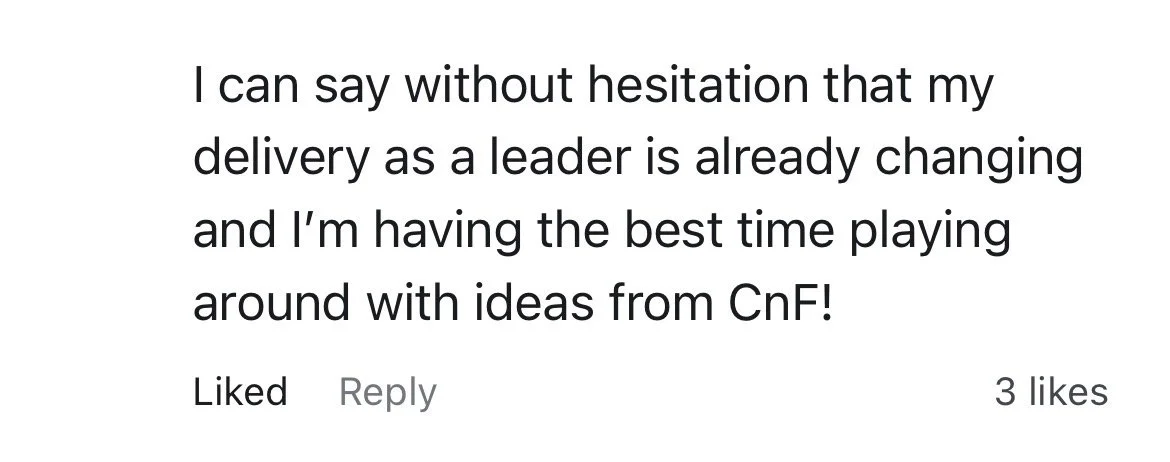
Really! Look:
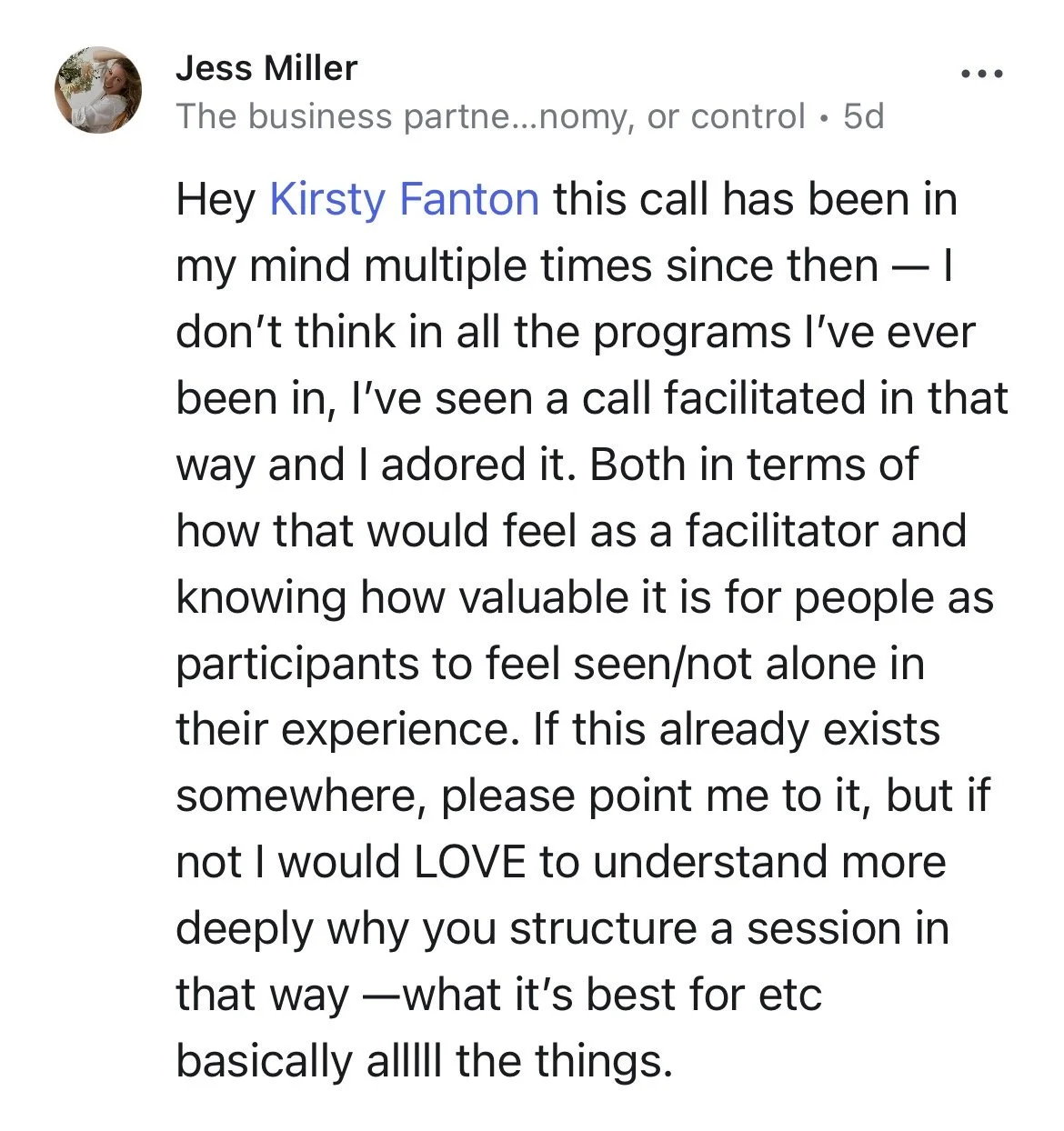
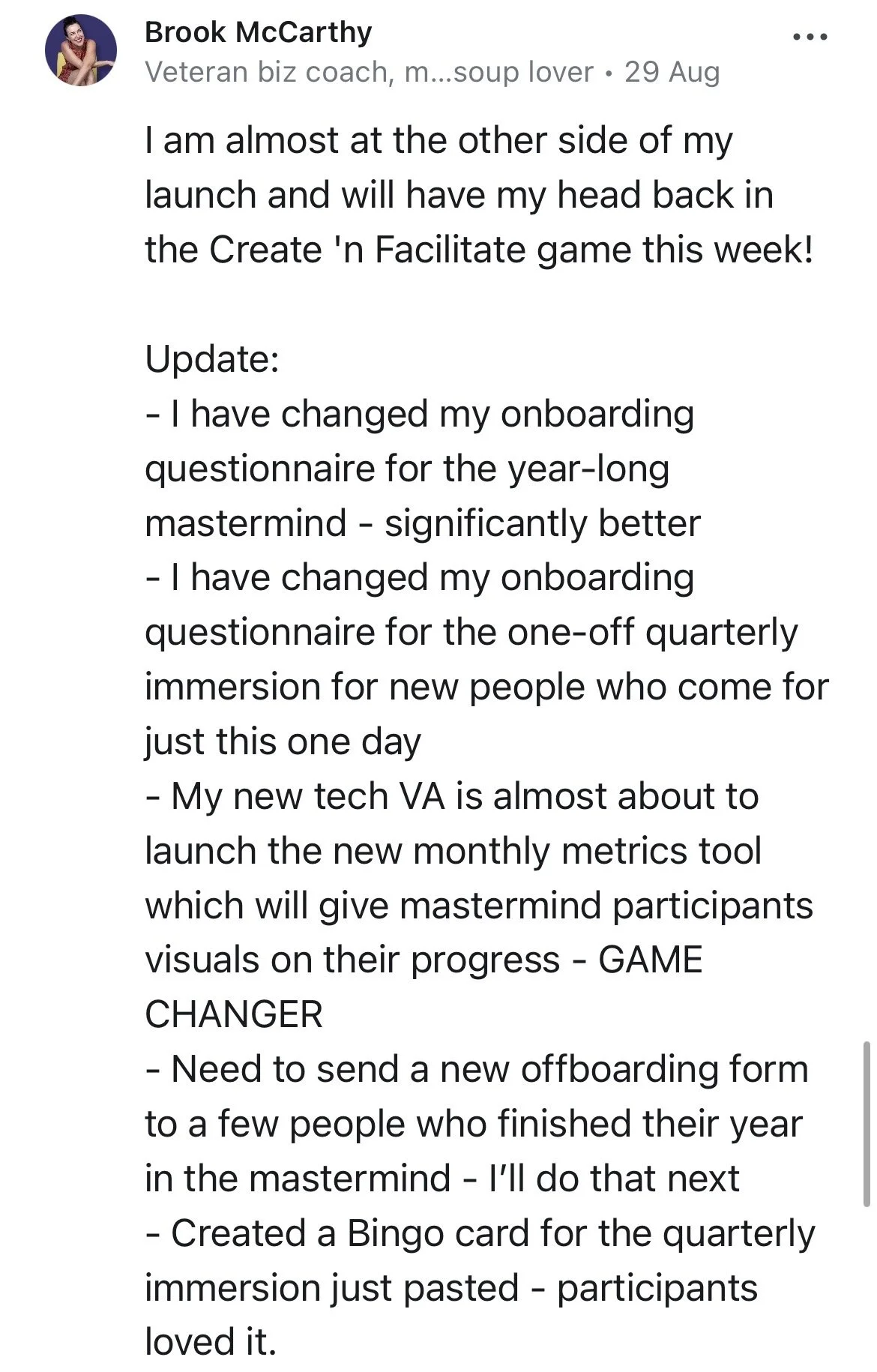
We have 7 weeks together
(from October 12th ‘til November 27th)
where we work on one key outcome per week, with a mix of experiential learning, individual implementation, and 1:1 support
Here’s what it looks like…
Week 1: Diagnosing challenges
We kick off our 7 weeks together by getting clarity on what’s not working in your group container — or where you’re worried things might fall down — and why.
The thing with the work we’re doing in Create ‘n Facilitate is that every piece of the puzzle (design, onboarding, facilitation, offboarding) has an impact, which means the symptoms you’re seeing in your space can be a result of more than one — often interrelated — thing.
For example, an over-reliance on you (aka 1:1 work at 1:many rates… with a Slack group 🙃) could be a result of:
An onboarding experience that doesn’t intentionally connect someone to the group in a way that explicitly highlights the value of moving through the space with other people
A facilitation style that focuses more on individual support than shared wisdom and experience
Design choices that stunt or negate the value of the group (e.g. Q&A style calls, ready use of DMs/other private channels)
The way you market your offer (How do you position it? Price it? Who do you attract? And what impact does that have on how people interact with it once they’re inside?), and
The way you communicate and hold your boundaries… which is almost always tied to whatever conversations of ‘worthiness’ or ‘value’ are happening inside your head
In other words, it’s important to get visibility on what actually needs your attention before you make any tweaks 😉 To that end, we’ve got a 90 minute session on Wednesday October 14th at 9am AEDT, where you’ll meet the crew, and diagnose the cause of your group offer’s challenges in real time.
Expect to roll out of this week with confirmation the wonky bits of your group space are a) normal, and b) fixable — along with specifics on what needs to shift.
Week 2: Intentional (re)design
This week is all about using last week’s findings to get strategic about how your space looks and functions. Think: touchpoints, inclusions, bonuses, platforms, decisions around group size and enrolment schedules, application-based entry or open-to-all, different tiers, gamification, and static vs experiential learning.
Since every group space is deliciously unique (and there’s no way we could cover the ins and outs of it in a group workshop), you get a Claude skill (‘Intentional (Re)Design’) to guide you through the process. Expect it to prompt you for all sorts of intel about your space, teach you about learning design, experience architecture, gamification + reward, and cohort-dynamics as you go, so you don’t just wind up with decisions, but the strategy and rationale behind them.
The skill works with you to create a (re)design google doc, which you can then submit to me for 1:1 feedback in the second half of the week, so you can get answers to your deliciously individual questions, asynchronous sound-boarding, and suggestions for optimisation.
Expect to roll out of this week with a space that honours your boundaries and capacity, leverages your strengths, and makes it very bloody hard for the people inside to feel unseen, get lost, or fall behind.
Week 3: Setting your members up for success
Now you’ve made some deliberate, informed decisions about your space, it’s time to create the assets that bring it to life. This week will be all about choosing your group platform/s and tech stack, crafting your application/onboarding process, and proactively setting norms and expectations for your space.
Since everyone’s dealing with layers of very specific context, you get a Claude skill (“Exceptional Onboarding”) to guide you through your build, as well as individual feedback and optimisation (provided via Google Docs) of your application and/or onboarding process.
By the end of this week, you’ll have your foundational group structures in place, as well as an onboarding process that makes your members feel held, excited, and confident about stepping into your space.
Week 4: Core facilitation skills
The design of your space and the pathway/s into it are taken care of, which means it’s time to turn our focus to the facilitation skills that bring the space to life. Think:
Setting an interaction up for success
Creating safe spaces
Mastering non-verbal communication
Asking better questions
Checking in and moving forward
Pinpointing the message underneath the words
Removing shame and facilitating sharing
Making complex ideas relatable
Offering useful reframes
Using silence effectively
Pushing back without hurting rapport
Use of self, and
Closing
Yup, it’s a lot, but don’t worry —
The expectation isn’t that you master all of these this week! It’s that you bring awareness to them, and get a handle on the ones you’ll turn to most often inside your space. You get access to the relevant Comms Camp modules (Comms Camp is my communication skills program — you'll get access to the relevant modules as a CnF inclusion) this week, and will maintain access as long as I’m in business.
The most impactful pieces of this week are the live workshop (November 4th at 9am AEDT) that links these skills together for common scenarios, and the Claude roleplay skill that allows you to test your instincts (and track your progress!) in an embarrassment-free zone. Expect a bunch of common scenarios, with varying levels of complexity, as well as the option to tailor them to the specifics of your space. You’ll get a debrief after each role play, with notes on the skills you used, what you did well, and what you can focus on for better results. Plus, it tracks your progress over time, noting key themes and competencies across scenarios (linking these back to the relevant core skills modules, in case you want a refresher), as well as a proposed pathway for honing the pieces that need attention.
You also have the option to opt-in to being in a roleplay group with 3 or 4 other members if you want to practice your skills with real, live human beings. I’ll match you by time zone and strengths/challenges, so you’ll fit together like a little human puzzle 🫶 I’ll also provide roles, scenarios, and a debriefing process so you can hit the ground running.
Week 5: The ‘inner game’ of facilitation
Skills and strategies are important pieces of the puzzle, but confidence, self-trust, and resilience are the things which really allow them to shine. This week is all about inviting fears (“ok, but what if I bugger this up on the first call?”), doubts(“who even am I to offer something like this??”), and resistance (“I don’t think I can call them out for asking too many questions… that’s not very kind, and, I mean, they *are* engaged…”) into the room, so you can:
See, quite clearly, that you’re not alone in these thoughts (and are actually in very good company)
Build awareness around when, where, and how these things are getting the way — for you and the people in your group space
Start strengthening more helpful narratives about who you are, what you’re capable of, and how you respond to (inevitable!) bumps in the road, and
Experience what it feels like to be a little vulnerable in an online space… so you can invite the same experience inside your space if and when it fits
We have a group therapy-style session (think ‘coaching’ session, but with a therapist’s slant) at 9am AEDT on Wednesday, November 11th, and — if you opted into the role play groups — those kick off this week too.
Week 6: Reading the room and responding in real-time
We’re dialling up the difficulty this week, and building your skills and confidence in responding to challenging situations in real-time. Think: when someone dominates a call — or the threads in the group space, when engagement dwindles, when the group moves off-topic or threatens to run overtime, when loose or leaky boundaries emerge, when someone makes an inappropriate comment or disclosure, and when there’s a whiff of argy-bargy (…to name a few 😉).
We’re letting loose and having fun this week, with a live session at 7am AEDT on Tuesday November 17th, where I’ll role play tricky scenarios (with one of my nichely-famous internet friends, so you can kick back and relax!) and engage in reflective practice in real time.
The idea is you walk away with some examples to leverage, as well as proof that even the pros are always learning and iterating (basically, I want to model awareness and improvement > perfection).
The roleplay pods and Claude roleplay skill will continue to be in action this week, so you can continue to hone your skills and instincts—
And, of course, bring your sticking points to the group space so we can help you move through them.
Week 7: Ending with intention
We kick this week off with a shiny new ‘off-boarding and upselling’ Claude skill that steps you through how to end your space — or someone’s time in it — in a way that feels good for all involved, and naturally invites further work/collaboration/opportunities. Your bonus Social Proof Sidekick (aka an interactive tool that helps you collect, select, and leverage social proof to sell more stuff to the right people) also comes in handy here, as you (re)build your feedback survey in a way that collects the most valuable insights.
You can submit your feedback form and offboarding pathway for 1:1 critique and optimisation anytime before 5pm AEDT on Friday the 27th.
We then have our final call at 9am AEDT on November 26 to wrap up your experience, and model this week’s skills in action.
The group space (think of it like a single-channel Slack group, hosted in Circle) closes on the 27th, but you’ll retain access to it in a read-only capacity until the end of December, in case there’s something you need to dive back in and reference.
Enrollments close October 2nd
More of a visual processor?
This version’s for you 😉
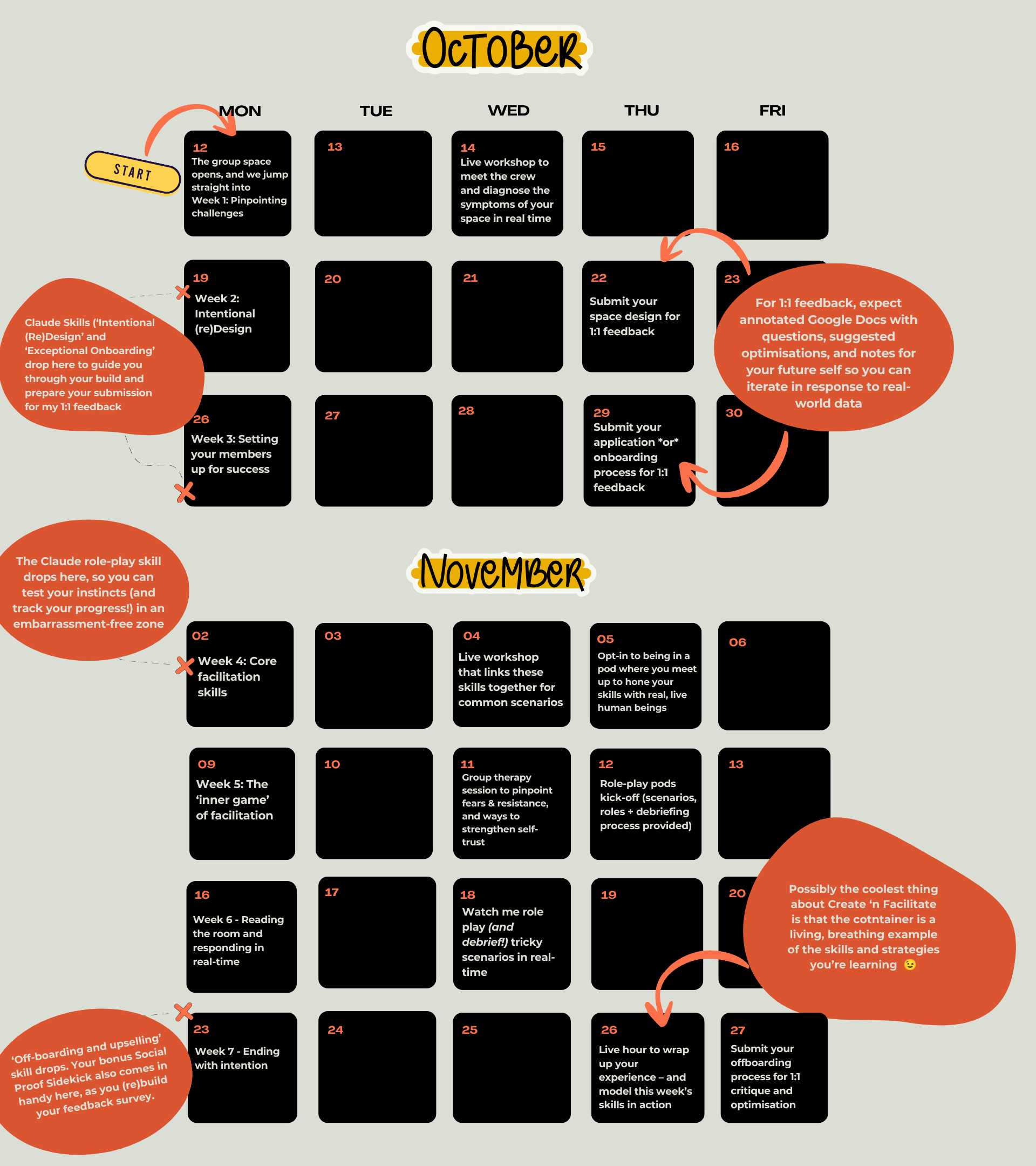

In case it wasn’t clear, there’s a deliciously meta angle to Create ‘n Facilitate in that the container is a living, breathing example of everything you’re learning
Every design decision (the mix of touchpoints, the onboarding, the group space, the way 1:1 feedback is woven in) is a working example of the principles you learn about in weeks 1, 2 and 3—
And every interaction is a real-life example of the facilitation skills you’re mastering in weeks 4 to 7.
The idea is that it’s an active, lived learning experience — an opportunity to be inside a well-run space, noticing what makes it work, week by week, so your reference point for shifting things in your own group space is more than just ideas on a google doc.
So, if you're here because nobody's posting in your group thread and you can't figure out why…
→ You'll get the tools to redesign your discussion spaces so they have a clear purpose and a built-in reason to contribute
→ You’ll see how this strategic design starts in the onboarding process, and build an understanding of how to lay out dots you can later join for the benefit of the group and people’s experience inside it
→ You’ll build confidence in the facilitation skills that can revive a dying space (aka naming, reflection, normalising, use of self, and asking better questions), and
→ You'll be inside a group space that has its own pulse — one where you can observe in real time what I'm doing to create it, and are encouraged to ask me about the mechanics of my approach
If you're here because attendance is dropping off and, if you're honest, your live calls could have been pre-recorded workshops…
→ You'll learn how to design your calls so they’re distinct and necessary parts of your space(i.e. not ‘nice to haves’ or zooms where you do the same thing you can do in the slack channel… just with the added friction of showing your face 😉)
→ You’ll grasp the shift in facilitation between a call that lands the same live as it does on the recording, and one that delivers an experience people actively show up for, and
→ You’ll attend calls that demonstrate both of these things, noticing the structure, the pace, the bar for engagement (and how that shifts in response to what’s in the room), and what makes you want to show up each week instead of catching the replay
If you're here because you freeze when someone dominates a call, the room goes flat, or something comes up you weren't prepared for…
→ You'll build the skills to respond, in a space that’s designed to be safe enough to try things, get them a bit wrong, and iterate
→ You’ll be supported to dive into the ‘inner’ stuff(e.g. beliefs, doubts, fears, and narratives) and begin to work through things that would otherwise block you from making the jump between theory and practice — and perhaps consider how an element of this could support the people in your space to reliably better outcomes, and
→ You’ll see how the touchpoints (i.e. the Claude roleplay skill, the live roleplay calls, and the roleplay groups)scaffold and stretch your skills and confidence in a meaningful way
You picking up what I’m putting down?

I've stopped questioning myself because I have a toolkit of ideas to pull from, plus a reframe to think about how to create the types of experiences that my students will truly benefit from.
I don't do a lot of "courses" but so glad I chose to do this program."
- BRENNA MCGOWAN, PRE-LAUNCH STRATEGIST + COPYWRITER
"I just feel like I'm better equipped to make decisions about how to be a better facilitator.
First up, a question for you…
HOW MANY OF THE PEOPLE WHO ENGAGE WITH YOUR SPACE FIND WAYS TO KEEP WORKING WITH YOU, WHETHER THAT’S VIA RENEWING THEIR MEMBERSHIP OR FLOWING THROUGH TO YOUR OTHER OFFERS?
I’m going to take a guess here, and say it’s a lot, thanks to the fact you’re very bloody good at what you do, and you give a damn about the people you work with.
If that’s the case, the limiting factor in continued service provision (i.e. upsells, onsells, renewals) is how deeply people engage with your space in the first place.
Create ‘n Facilitate offers a way to meaningfully increase engagement with (and therefore outcomes from!) your space, which means you don’t just wind up with a container you’re proud to offer, but a lifted line of revenue from it.
Think about some of the social proof you’ve seen on this page —
Snippets like this one from Liz Green: “The only change I’d like to see is for it to never end, and I’ll be sleeping up against the doors of this until you’re ready to offer it again”, and this one from Susanna Tham: “if I could, I would stay in it for life.”
What would it mean if people said things like that about your container — and acted accordingly?
The next thing I want to invite you to consider is this:
WHAT KIND OF IMPACT WOULD STELLAR SOCIAL PROOF — AS THE NORM, NOT THE EXCEPTION — HAVE ON YOUR CONFIDENCE ABOUT YOUR SPACE, AND YOUR ABILITY TO PROMOTE IT?
I’m not talking about the kind but ‘thin’ feedback most people in your shoes have, like “great course! Really glad I invested” and “Amazing workshop! I took so many notes, and can’t wait to implement”, but the stuff that goes way deeper, and paints the kind of picture your ideal prospect can’t wait to step into.
I’m also not talking about the two or three tidbits you have from your star students — and keep recycling every launch. I’m talking about having an overwhelming number of pieces to pull from, so that even your most sophisticated buyer accepts that you’ve got something special going on.
Create ‘n Facilitate is a
$997 USD investment—
Which will either feel like a no-brainer or have you
grimacing at your screen
First up, if you flat out can’t afford it right now (and hey, I get it — the 2020s are 2020-ing hard for some of us!), please go back to your day, and know that I plan on offering it again in future.
If your grimace is more about some other kind of friction, keep reading, not so I can bully you into buying—
I’d genuinely rather eat my own toe-hair, not just because I’m all-in on ethical selling, but because the success of a group space starts with helping the people it’s specifically designed to support to meaningful outcomes opt-in, and the ones it’s not designed for opt-out (geez, we’re getting a bit meta already, aren’t we? 😉) —
But so you can make a confident call, either way.
Of course, the road to getting this kind of social proof is two-fold:
Create an experience that’s exceptional, and reliably leads to meaningful outcomes for the people inside (which is precisely what we’re working towards), and
Ask the kind of questions that unearth this data, motivate people to answer them, and then go about leveraging them strategically (which is part of what we tackle in week 7 — I’m even gifting you The Social Proof Sidekick in order to do it)
In other words, the question isn’t whether it’s possible for you — it’s what will it mean for you moving forward.
The final nugget I have for you…
IS THAT CREATE ‘N FACILITATE COMES WITH A NO-QUESTIONS-ASKED MONEY-BACK GUARANTEE YOU CAN CASH IN ANYTIME DURING OUR FIRST WEEK (up until 5pm AEDT Sunday October 18th).
No hoops to jump through, or ‘homework’ to submit. Plus, I’ll remind you of the deadline in case you want to cash it in. The only Q I’ll ask will come after I’ve initiated the refund — and it will simply help me get a handle on what didn’t click for you, so I can work out what to change about the container or my marketing of it.
If $997 USD now feels like a good price, and your ability to try it risk-free is the nudge you needed, let’s make it official
Enrollments close October 2nd

(Now, my space is) Far more structured. More discipline in who is allowed in, who will be invited to renew (and who won't!). More automation added because it was too laborious for me (and I tend to be forgetful).
I'm more confident in certain decisions, because I know there's a process and structure and best practice behind online group facilitation that's not stupidly simplistic or prescriptive, but thoughtful, nuanced, and adaptive.”
- BROOK MCCARTHY, BUSINESS COACH
"I wanted to feel more in control of this juggernaut I'd created. I needed to stop being so bothered by people, and wondering too much about where my responsibility begins and ends.

Still here?
Let me guess — you’re stuck on the fact that you’re clever, experienced, and good at what you do… and surely this means you can
work this out on your own
(or, as is the current way of the world, with some help from your mate Claude)
There are some things I want you to know…
→ Designing and facilitating group spaces are a completely different set of skills from your core skill
In other words, I have no doubt whatsoever that you are clever, experienced, and one of the top people in your niche, and — since you’re all the way down here — there’s some element of your group space and the way you deliver it that you don’t yet have mastered.
Both can be true 😉
And you know what the research tells us, over and over again?
→ Poor facilitation can ruin great content, whereas excellent facilitation can elevate even mediocre material
Read that again.
Fact is, people are more likely to take action when they feel supported.
They’re more likely to ask questions when they feel safe.
They’re more likely to follow through when they feel seen.
They’re more likely to push through the hard bits (the resistance, the doubt, the weeks where everything feels like too much and nothing’s working the way it should) when they trust the container they're in.
The experience of being in your space isn't a nice-to-have alongside the content. It is the product…
→ Facilitation is a deeply human, interpersonal skill
Which means that while AI can help pinpoint which skills you need to hone, it can’t get you all the way there.
It’s kind of like when you’re practicing an upcoming workshop in front of the mirror. You’re saying all the right words, in the right order, leaving appropriate gaps for laughter and drop-down ‘aha!’ moments…
But you’re not responding to the room.
You’re not dealing with the unpredictable nature of a live audience (the Qs in the chat that pull you off-track, the person who joins 10-minutes late with an unmuted mic, the disclosures that necessitate a change in pace, the blank faces that tell you the thing you’ve just shared hasn’t landed), or glitchy tech, or the nerves that make you speakreallyreallyfast in the moment.
And it’s your ability to respond to that stuff — in real-time, in a way that’s genuine — that makes your stuff come alive. That creates some magic in the room.
The same thing is true right across your group space.
If any of this is resonating, I’d love to work with you. Truly!
Click the big orange button below and let’s get started.

Ready to whip your group space into the best possible shape
— for you, your business, and the people inside?

FAQs
When does Create ‘n Facilitate kick off?
We start on Monday, October 12th and wrap up on Friday,November 27th.
When are the live calls?
We’ve got 5 live calls throughout the program:
Wednesday October 14th @ 9am AEDT: A 90-minute workshop to meet the crew and diagnose the symptoms in your space (and pinpoint their cause/s) in real time
Wednesday November 4th @ 9am AEDT: A 90-minute workshop that links core facilitation skills together for common scenarios
Wednesday November 11th @ 9am AEDT: A group therapy-style session (think ‘coaching’ session, but with a therapist’s slant) to bring awareness to the thoughts, beliefs, and narratives that shape your ability to show up and lead a space
Tuesday November 17th @ 7am AEDT: a live session where I’ll role play tricky scenarios (with one of my ‘internet famous friends’, so you can kick back and relax!) and engage in reflective practice in real time.
Thursday November 26th @ 9am AEDT: A 75-minute call to wrap up your experience, and model this week’s skills in action
All calls will be recorded and available to dive back into at will.
If I can’t make the calls/am gallivanting around on holiday for a couple of weeks while the program runs, is that a deal breaker?
If you’re going to be offline for a significant chunk of the program, yep — you should sit this one out! We’re moving quickly and deliberately inside the container, so if you get more than a week behind, it will be hard to catch up (also: this is your reminder that great facilitation starts when you help people make really informed choices about whether or not the space will give them what they need before they join it 😉).
Is there any kind of refund available if I join but work out it’s actually not a fit for me and what I need?
Yep! Create ‘n Facilitate comes with a no-questions-asked money-back guarantee you can cash in anytime during the first week.
No hoops to jump through, or ‘homework’ to submit. Plus, I’ll remind you of the deadline in case you want to cash it in. The only Q I’ll ask will come after I’ve initiated the refund — and it will simply help me get a handle on what didn’t click for you, so I can work out what to change about the container or my marketing of it.
I facilitate in-person/IRL spaces. Is this a fit for me too?
No, this is specifically for people who facilitate online spaces. While there’s definitely (a lot!) of crossover in terms of the design and facilitation skills you use both online and in-person, there are also some key differences that Create ‘n Facilitate doesn’t specifically account for. If you’d like to see an offer specifically tailored to in person/IRL spaces in the future, let me know!
I'm actually about to launch my program — is this going to be too much to take on at the same time?
First up, one of the most common themes in the feeback from the first round of Create ‘n Facilitate was that small, immediate changes (e.g. better framing for your next call, a hit of gamification to re-engage your members, some small-but-mighty tweaks to your onboarding) made big differences. In other words, the path to meaningful implementation is short ‘n sweet ;)
Plus, if you're building or optimising your space right now — figuring out touchpoints, onboarding, your tech stack, what your first call actually looks like — you're doing exactly what Weeks 1 and 2 of Create 'n Facilitate covers. The difference is you'll be making those decisions with a framework instead of instinct, with real-time feedback instead of guesswork, and with a group of people building alongside you.
Same can be said for building out your onboarding (Week 3), honing your facilitation skills (Week 4, 5, and 6 — also, I would actually LOVE it if your program crosses over with this one! That way you can bring real, happening-now challenges into the space and we can work through them together), and building out your offboarding process and pathways (Week 7).
To be clear, you WILL be busy, but a lot of that will be with tasks you have to tackle anyway. If you do decide to join, it will mean you’re tackling them with more structure, more support, and fewer expensive lessons learned from your first real cohort.
Plus, you'll leave Create 'n Facilitate with a space you're confident and excited to sell — something that will make a significant difference in your launch.
Do I keep access to everything after the program wraps?
You’ll have access to the call recordings and group space (in a view-only capacity) until the end of December, and will have access to everything else (the core facilitation skills modules, Claude Skills, and your 1:1 feedback docs) as long as I’m in business 😉
I know I want to create a 1:many offer, but I’m not 100% sure what that is yet… can I still join?
It depends on what ‘not 100% sure’ means for you. Create ‘n Facilitate is for people who either already have a space they want to optimise, or who are clear on the ‘what it does and who it’s for’ components of a space they’re about to offer for the first time. So, if you have question marks around some design decisions (e.g. Should your space be cohort based or evergreen? Should it have weekly coaching calls? Or a group space for asynchronous support? What about 1:1 touchpoints?) or know you need to refine the inclusions (e.g. you know people get stuck somewhere in module 3, but aren’t quite sure how to fix it) that’s great — you’d definitely be in the right room. On the other hand, if everything except the fact you want to offer some sort of group space is a question mark, this isn’t for you — at least not yet!
I’m already a pretty experienced facilitator. Is this for me, or more for people at the beginning of the learning curve?
Most people who’ve been through Create ‘n Facilitate aren’t new to facilitation. They’ve been running online spaces for 3 to 10 years, have backgrounds in education, coaching, or therapy (i.e. jobs that rely on your ability to communicate and support people well). The thing they don’t have is any formal training, or anywhere or anyone to go to when their space gets glitchy. So, if you’re pretty decent, but you’ve got that way through trusting your intuition, and you have a niggling sense there’s room for improvement, this is for you.
I CAN’T DECIIIIDE! Help!
Drop me a line at hello@kirstyfanton.com — messy thought-dumps welcome.