
The Create ‘n Facilitate
Roleplay Gym
10+ years of group facilitation experience, distilled in a nifty interactive tool designed to build your skills and confidence in an embarrassment-free zone
Facilitation is one of those skills you can’t just learn about on paper
Well, you can, but it won’t get you very far—
Thanks to the fact there’s a world of difference between:
(a) knowing the theory, and
(b) putting it into practice with a group of real, live human beings
Especially when those human beings aren’t behaving as you expect them to.
Think…
→ That outspoken group member you SWORE you were going to pull into line on today's call… who accepted your first redirect ("Totally fair, I do jump in a lot — sorry!") but then continued hogging the space as if nothing had changed
→ The juicy discussion question you lobbed into your implementation session — the one you were sure would crack the group open… that was received with the energy of eleven people suddenly *very* interested in their fingernails
→ Or the hard conversation you rehearsed beautifully in the shower… that came out sideways the moment an actual human responded with something your script hadn't accounted for

I mean, you can (and probably will) try again
in the space itself—
But when you've already tried and missed the mark, the stakes feel so much higher
The group (or key people inside of it) clocked attempt number one, which means attempt number two isn’t just "handling the situation" anymore —
It's handling the situation while carrying the memory of last time, in front of the same audience, with a smaller margin for error.

Which is exactly why "just build your facilitation muscle as you go" is such high-risk advice.
What you actually need is somewhere to run attempt two (and three, and four, and eleven 😉) where the first swing-and-a-miss isn't in the room…
A space where you can get support as you go…
Somewhere the stakes reset to zero, every single time.

This is precisely where the Roleplay Gym
enters the chat
It drops you inside the exact situations playing out in your group space (plus an infinite number of others, if you want to pre-emptively stretch your skills and build your confidence) and allows you to test and iterate in real-time —
Zero stakes, the ability to pause mid-scene and get support, and end-of-scene feedback that tells you what actually worked, and what you could do differently next time for better results.
Here's what a session looks like:
Step #1: You set the scenario
The Gym prompts you for some basic context about your group space (is it a membership? 10-person mastermind? Large cohort-based course? Something else? And how far in are you?) and asks whether you want to rehearse a real situation — in which case, it will prompt you for the context it needs to build something specific to your space, your people, and your dynamic, or if you want it to pick one for you. If you go with the latter option, expect anything from managing an over-talker or an off-topic tangent, to responding to a heavy disclosure mid-call, or navigating public pushback from your most respected member — all tied to the context you’ve shared.
Step #2: The scene runs — and the characters behave like actual humans
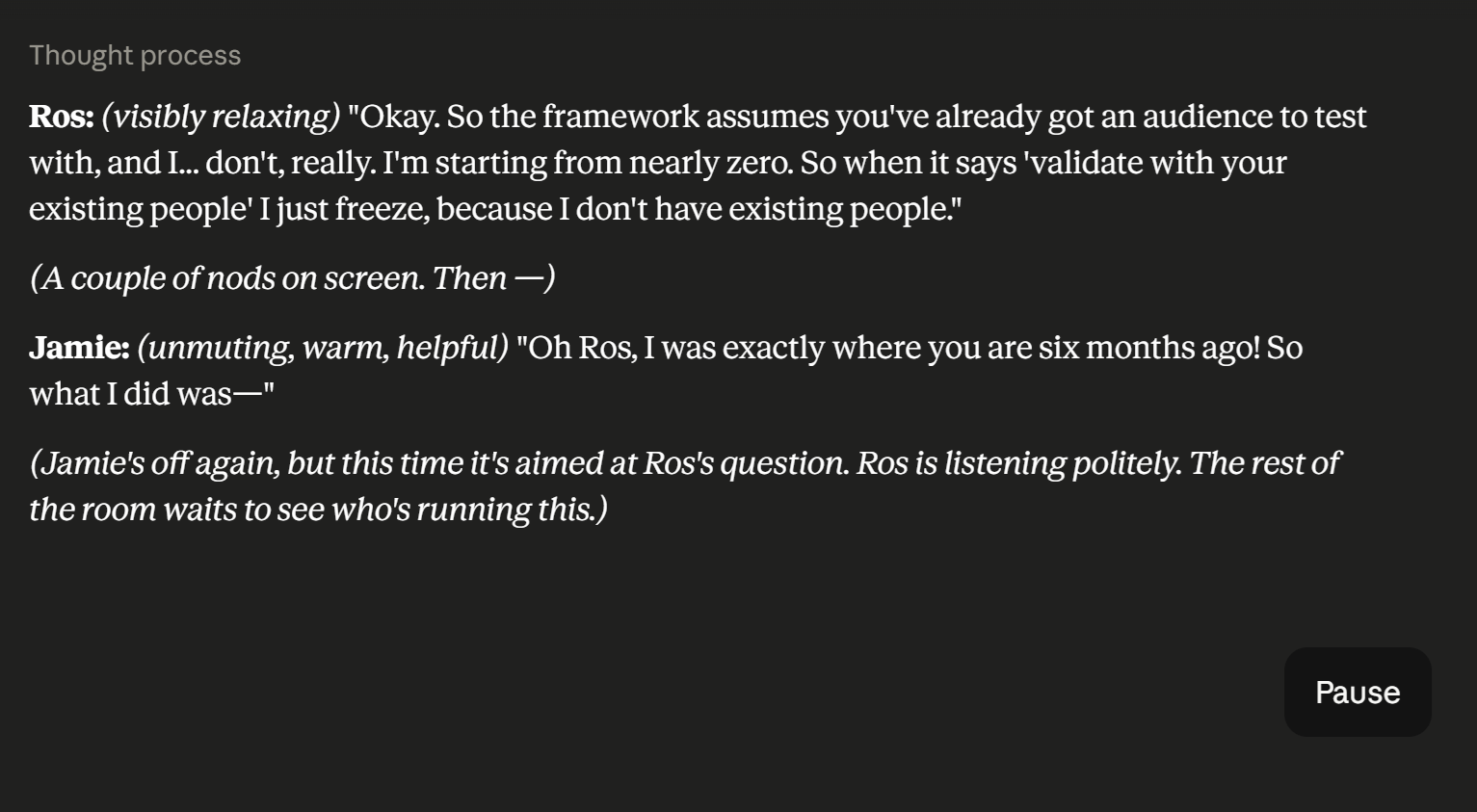
Fun fact: the participants in the Gym (i.e. the roles Claude plays) have inner logic. The over-talker genuinely believes they're helping, the nervous member takes any exit you offer from the hard conversation, and none of them fold the moment you say something vaguely competent. Say something skilful and it lands the way it would in a real room. Stall, placate, or dodge? The scene escalates — just like it would in the real word 😉
Step #3. You ask for help (if and when needed) as the roleplay progresses
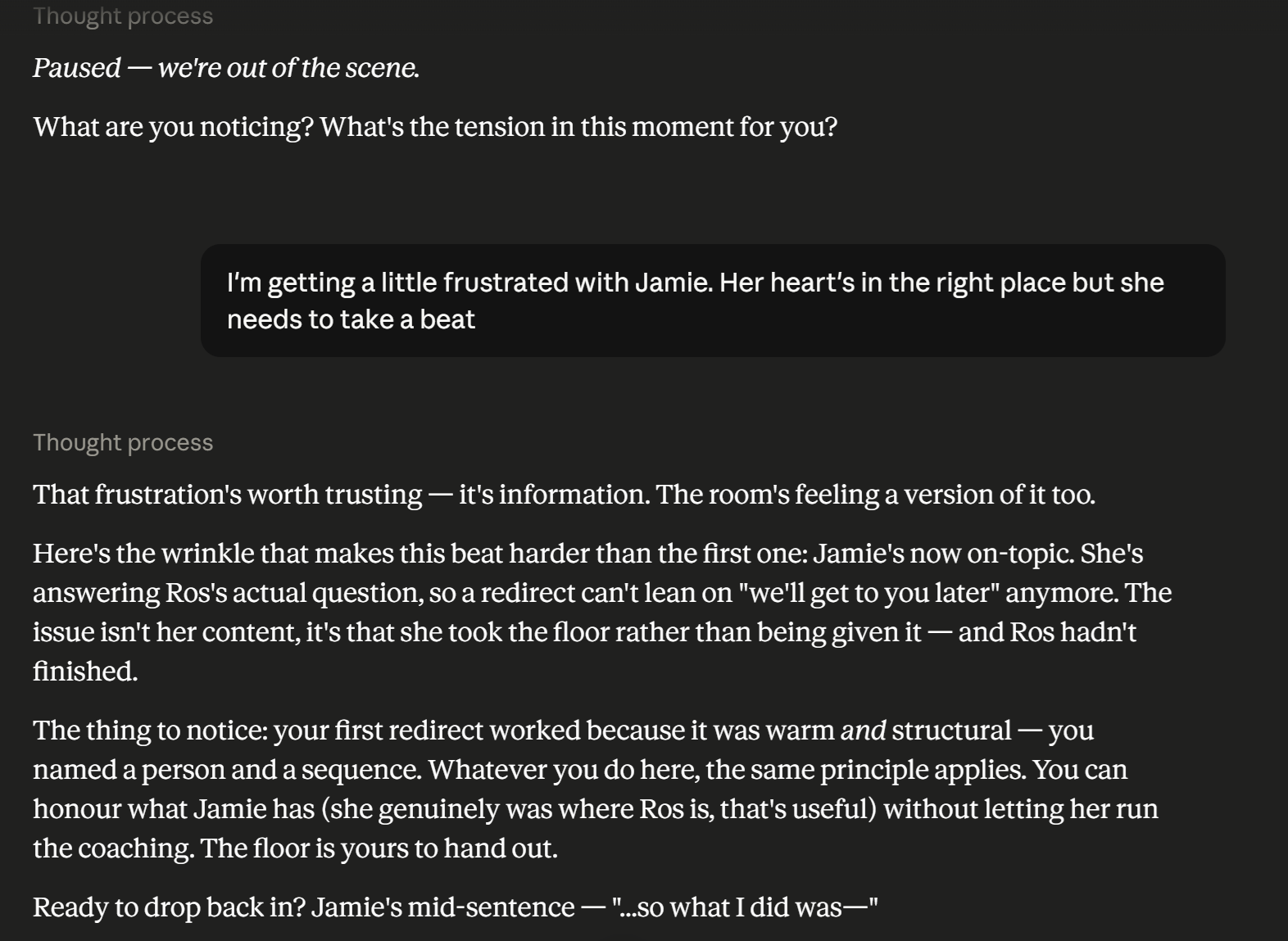
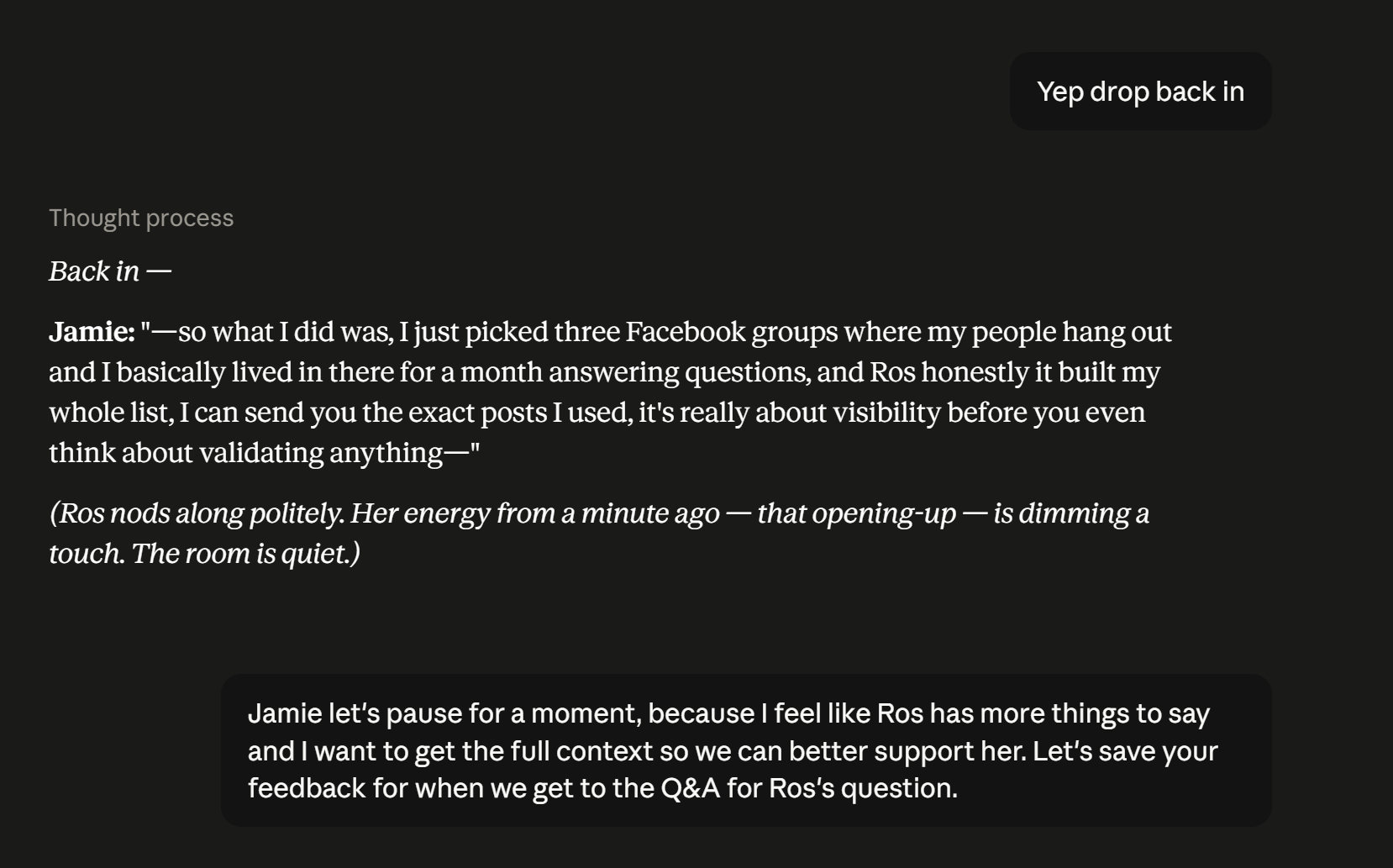
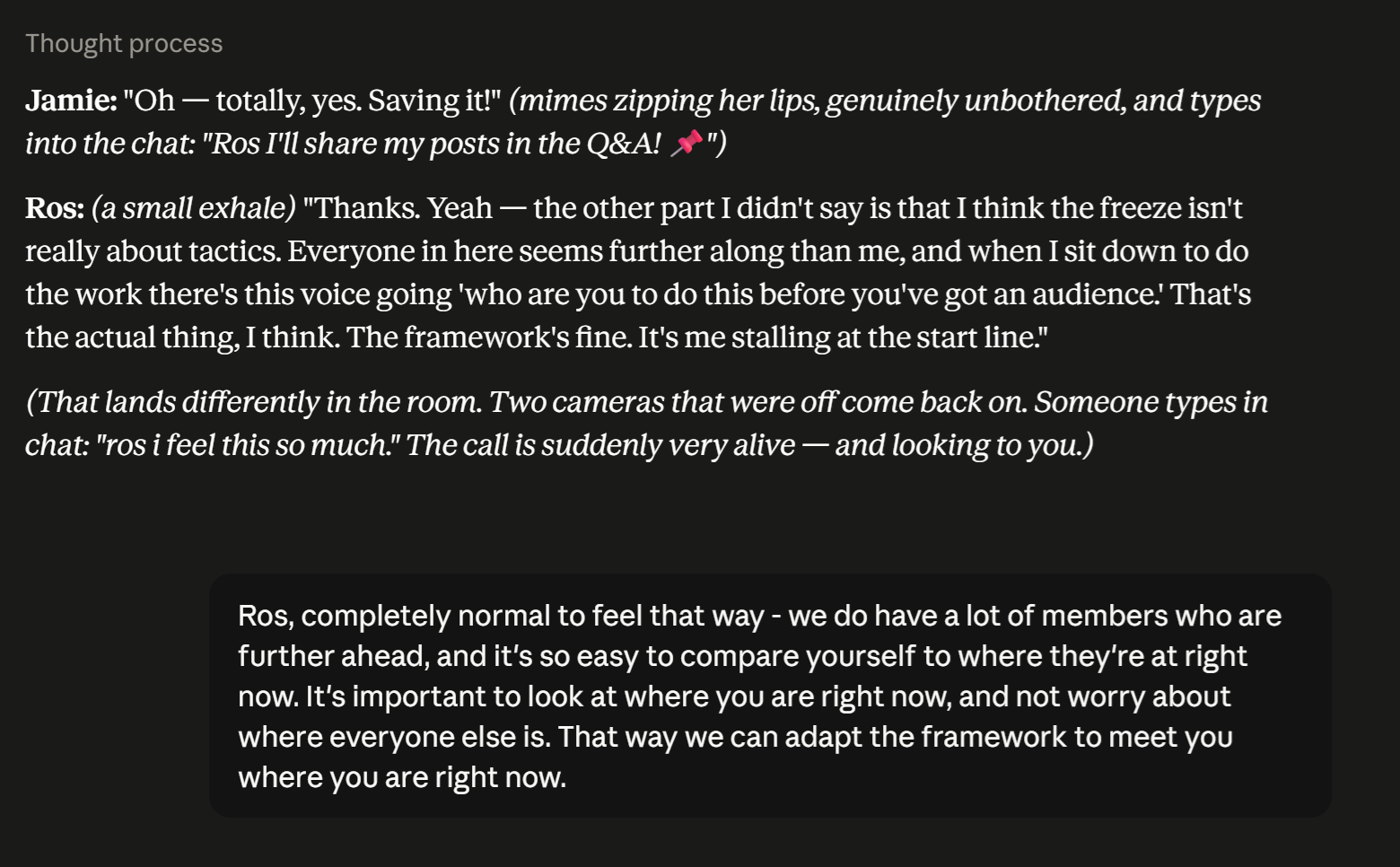
Simply type or say “pause” and the Gym flips into coaching mode. Since it’s built to mirror my approach, this isn’t about it swooping in with answers. Instead, it will prompt you on what you’re noticing, how you’re feeling, and what — specifically — is tripping you up. From there, it will help you scaffold a response that’s built on real skills and sounds like you, then (when you’re ready!) drop you right back in where you left off.
Step #4: You get a really robust debrief
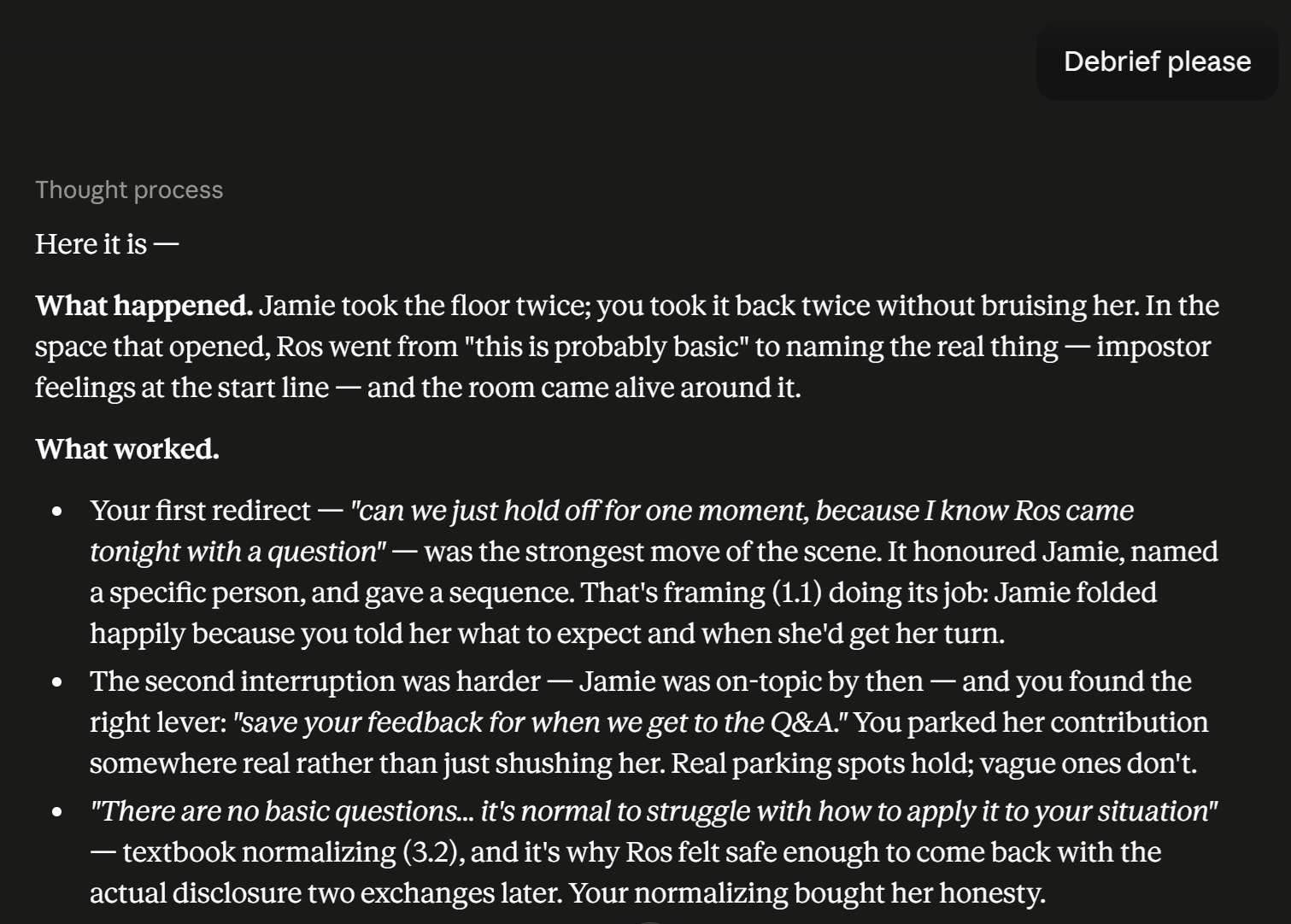
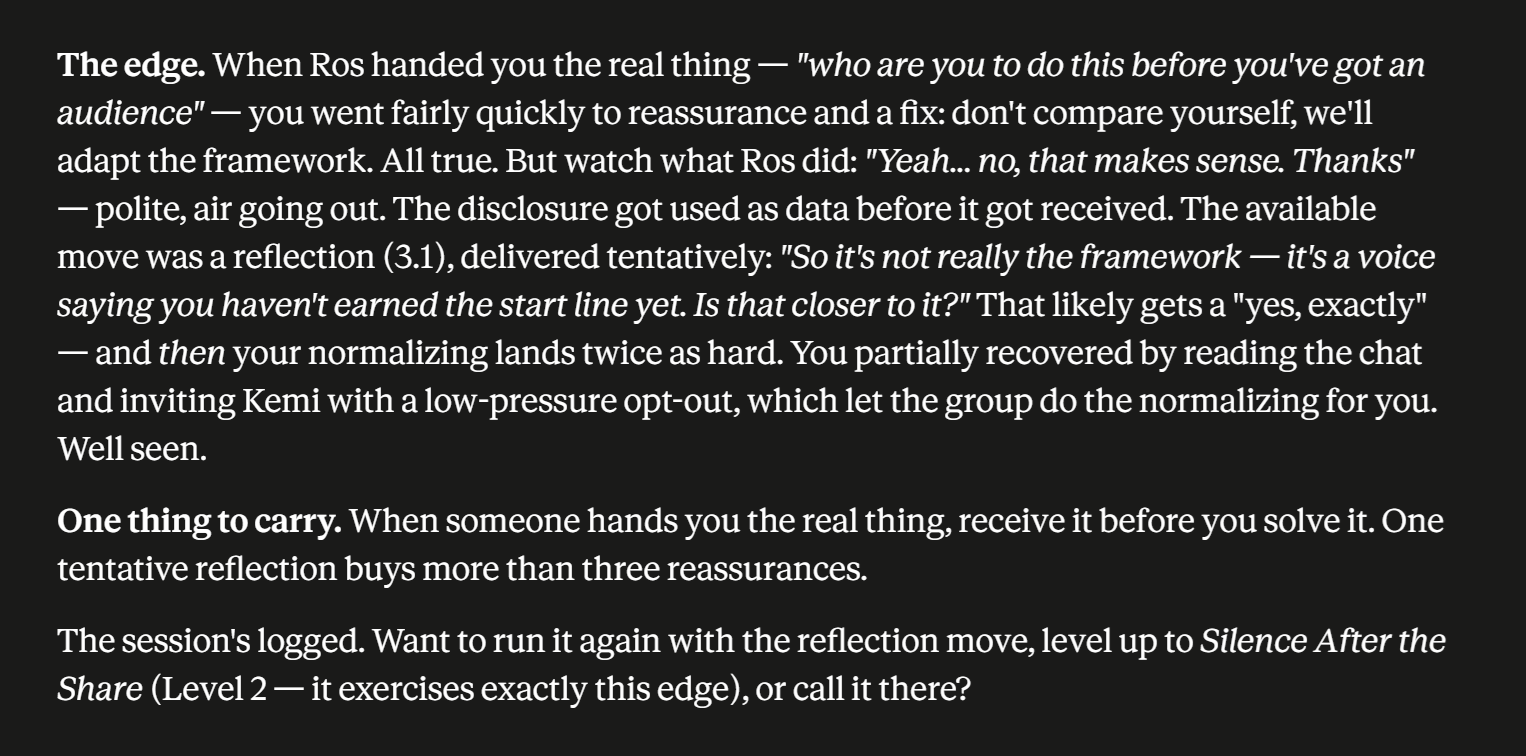
After every scene, the Gym will provide you with a debrief on what happened (naming the dynamics that were sitting underneath the behaviours, so you can build awareness on the link between symptoms and causes), what worked (quoting your actual lines, and naming why they worked), the moment where a different move was available — including specifics on that move, right down to an alternative line you could have said, and one thing to carry into your next attempt. It will end with 3 options: run the same scenario again, focusing on implementing the feedback you just received, level up (i.e. increase the challenge), or call it there.
Step #5: The gym folds this intel in to your progress report, as a way of tracking where you’re at, what you’re already doing well, and where you can focus for the most meaningful gains
The Roleplay Gym logs every session and reads that log before each new scene, so your practice builds instead of resetting. Every five sessions, you get a progress report: the patterns across your strengths, the patterns across your sticking points, and how you've shifted since last time. NB. If you want or need to change the context of your space or the people in it (e.g. maybe you’ve welcomed in a fresh cohort, or have an emerging dynamic between two members), you absolutely can! Just tell it you have some updates you want to fold in, and it will do the rest 😉
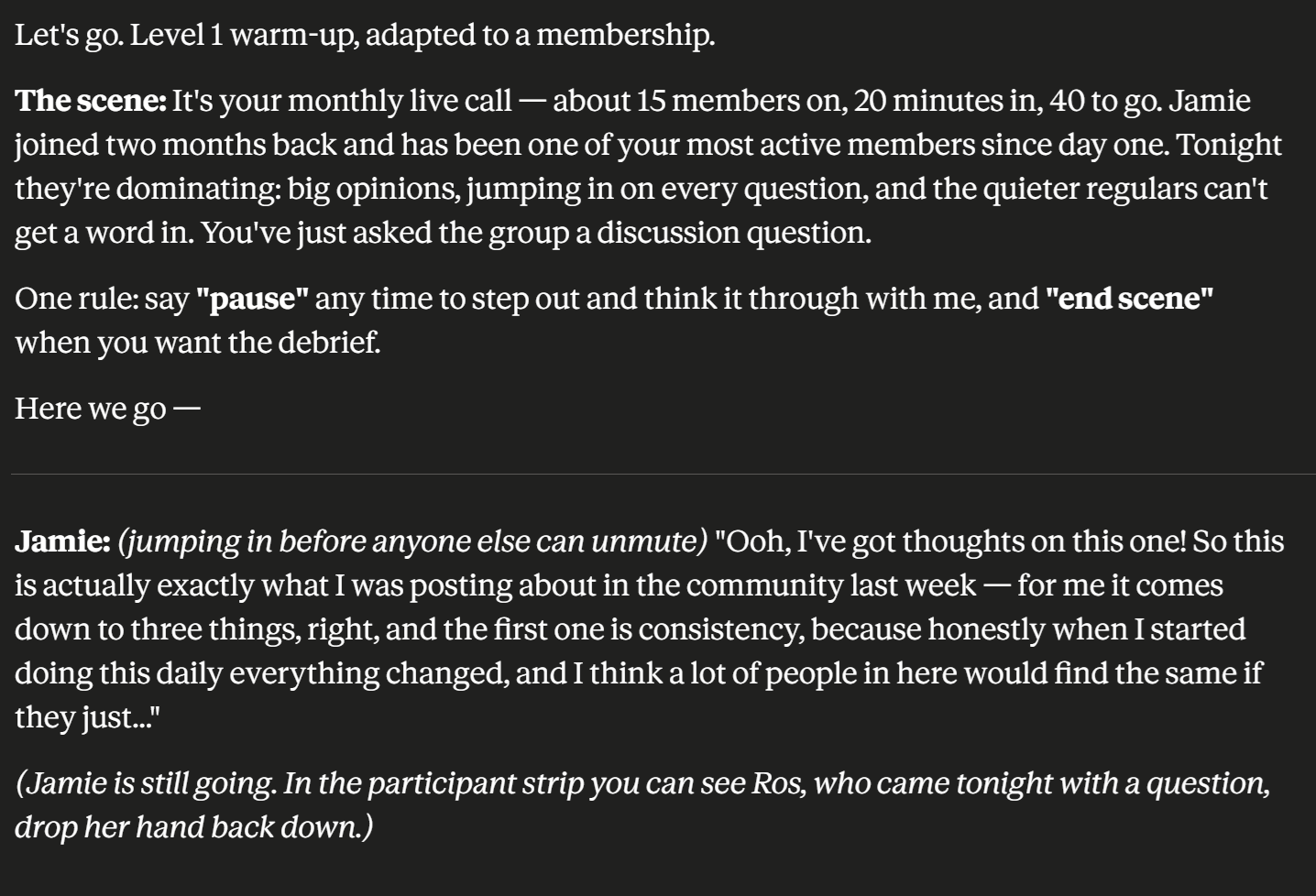
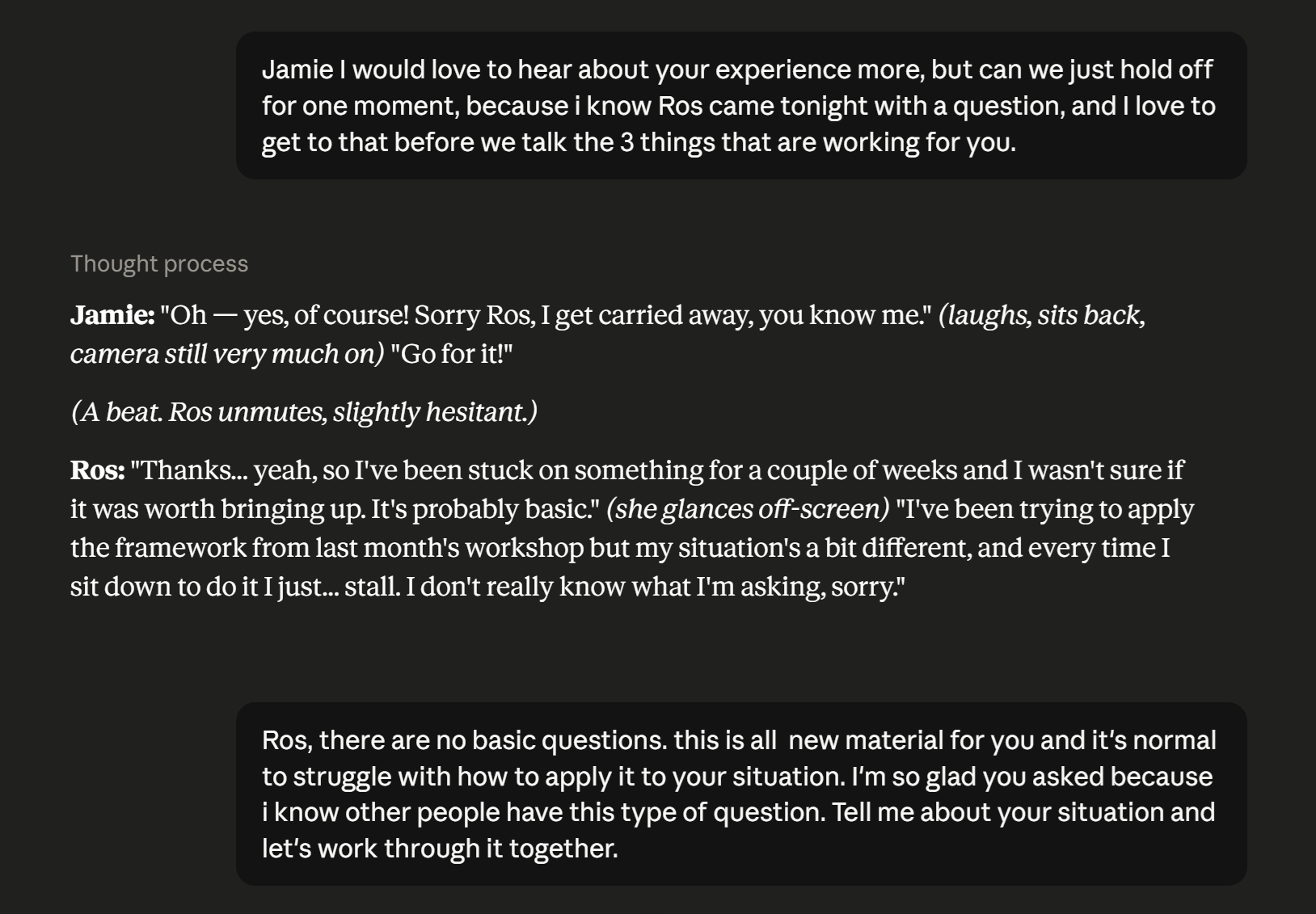
Wondering how all of this actually looks?
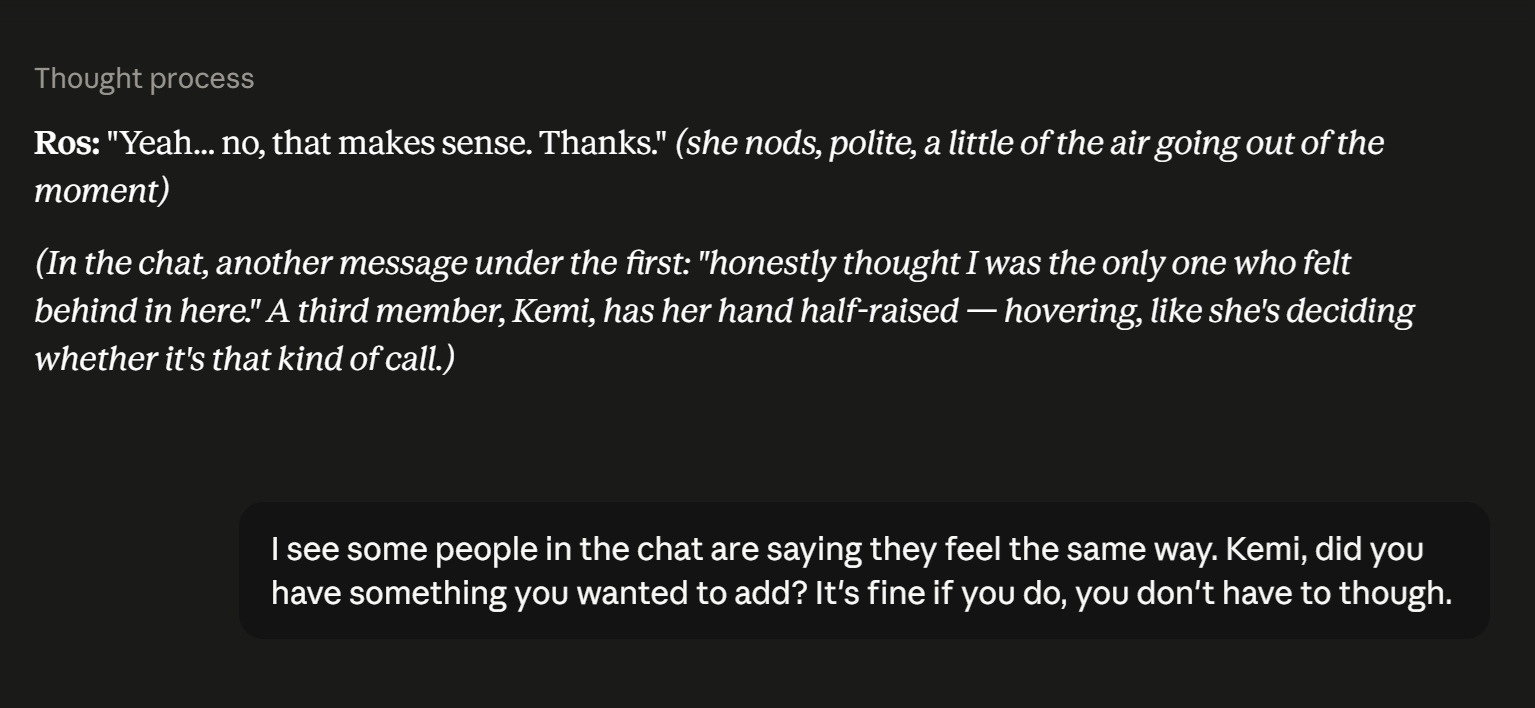
Here's an excerpt from a real roleplay — one where I asked for help, then jumped back in

“Ok, this is pretty cool, Kirsty… but couldn’t I just ask Claude to run these kinds of roleplays with me for free?”
You could…
But you wouldn’t get the same experience, thanks to the fact generic AI roleplay:
Is built to beagreeable — which might be nice in the moment, but won’t offer you anywhere near the same kind of skill development, and
Pulls feedback from various sources on the internet… rather than the IP of an ex-psychotherapist turned online business owner who has more than 10 years experience facilitating group spaces 😉
Basically, the Roleplay Gym is different because of what's wrapped up in the skill: a scenario architecture with characters who hold their ground, escalation paths that respond to avoidance the way real rooms do, and a support and feedback framework built on the same foundations I've used across 10+ years of designing and facilitating group spaces.
In other words: you're not buying access to Claude. You're buying access to my skills and expertise, packaged up in a way Claude can help you leverage.
In case you’re wondering…
This is for you if you facilitate any kind of online group space—
A membership, cohort-based programme, mastermind, or some other kind of online community, and you want the moments that matter most in those spaces to stop being the ones you wing.
New-ish to facilitation?
→ Start at Level 1 and build.
Ten years in?
→ Go straight to Level 5 and see if the room can still stretch you.
Not convinced?
Have a crack and let me take on the risk…
Try three scenarios in the 7-days after purchase, and if it's not for you, simply send an email to hello@kirstyfanton.com to initiate a refund.

Here's what's included
The Roleplay Gym skill — all five difficulty levels, unlimited custom scenarios built around your space, text and voice modes
Curriculum-grade debriefs after every scene, built on the Create 'n Facilitate core skills framework
The practice log and progress reports — your training arc, tracked and honest
A 3-minute install guide that assumes zero technical confidence (really — if you can rename a file, you can do this!)
Ongoing updates — the Gym is a living tool, and you'll get its improvements as they ship
Plus, if you love what you get out of the Gym, and want to take it further, you can credit your purchase towards a future round of Create 'n Facilitate.

FAQs
Do I need a paid Claude account to use this?
Free accounts can install and run the Gym, but free usage limits may cut a session short partway through a scenario. For uninterrupted practice (and voice mode on mobile), I'd recommend Claude Pro ($20 USD/month).
How is it different from me just opening up Claude and asking for a roleplay?
A generic AI roleplay folds the moment you say anything vaguely competent, flatters you, and teaches you nothing (sound familiar?). The Gym is built on my IP — characters with inner logic who need a real move before they shift, escalation paths that punish avoidance, and debriefs built on a framework from an ex-psychotherapist with 10+ years in the room (it me 😉). If it helps, remember you’re not buying access to AI here — you’re buying access to my skills and expertise, packaged in a way AI can help you leverage.
Just how varied — and how specific — can the scenarios get?
Short answer: very! The Gym ships with a bank of scenarios across five difficulty levels — everything from the over-talker hijacking your first live call, to the flat room where nobody's saying anything of substance, to a member questioning the value of your space in front of everyone. But the bank is just the warm-up act. Tell the Gym about your actual space (from the way it’s set up to the people and personalities inside) and it builds scenarios around your context. Plus, if you've got a very specific situation brewing — the member who sends four-paragraph DMs, the hard conversation you've been putting off since March — you can brief it accordingly, and it will drop you straight in.
I've been facilitating for years. Is this going to be too basic for me?
I don’t think so, for the simple fact that facilitation isn’t a one and done skillset. It constantly evolves to meet the situations you’re presented with, and the Roleplay Gym will learn where you’re at and uplevel accordingly. Think: heavy disclosures mid-call, public pushback from a respected member, a room that's quietly split down the middle.
Does it 'learn' about me and my space, a bit like Claude generally does?
Sure does! The Gym keeps a practice log: details on your space, every session you run, your strongest moves, and the edges you're working on. It reads that log before each session, so every roleplay builds on the one before — unless you come in with a specific scenario you want to jump straight to. Every five sessions, you get a progress report: the patterns across your strengths, the patterns across your sticking points, and how you've shifted since the last one. This helps you and the skill track progress and sticking points.
Can it help with my onboarding and offboarding? Or just 'in-program' interactions?
If there's a human in the interaction, you can rehearse it. That includes the onboarding and offboarding moments most people wing: the welcome message that sets the tone, the boundary conversation with the member who treats your DMs as a private coaching channel, and — everyone's favourite — the "I'm not sure this is the right fit" conversation, done with enough care that the person leaves feeling looked after rather than booted. What it won't do is design your onboarding sequence or your space itself — that's design work, not facilitation practice (and it's part of what we tackle inside Create 'n Facilitate).
Will it help me translate what I'm learning to the real world?
Yep! After every scene, the debrief shows you what worked (quoting your actual lines, not vague vibes), where a different move was available, and the one thing to take into your next attempt — then you can run the scene again and try it. There's also voice mode, which is an exceptional learning tool, thanks to the fact it forces you to practice out loud, with no time to redraft, and is therefore the closest thing to the real room. The final leap into your actual space is yours to take — but you'll take it with reps behind you, not just theory.
Can I re-run an interaction or call that didn't go so well?
Yes! And I would LOVE you to, because I think it’s one of the best ways to a) test some different ways of responding, and b) get over the ‘shame hump’ that comes when you know you didn’t nail something on the first go. Simply tell the Gym what happened — who said what, where it went sideways, the moment you've been replaying in the shower — and it rebuilds the scene so you can walk back in and try something different, as many times as you like, with a debrief each round. Which means the next time that situation shows up, you're not improvising or freaking out. You've got better responses already up your sleeve, and have said the tricky things out loud already.
Quick tip: as well as re-running interactions that didn’t go well, you can extend that with scenarios that role play your follow-up interactions (e.g. a DM with someone, a ‘let’s name the elephant in the room’ kind of post in Slack), so you can execute those with confidence.
How does the refund policy work?
Simply try three scenarios in the 7-days after purchase, and if it's not for you, send an email to hello@kirstyfanton.com to initiate a refund. That’s it - clean and simple ;)