

THE ROOM, REDRAWN · A FREE 6-DAY EMAIL SERIES
Understand the common (and complex!) dynamics at play in your zoom room — one hand-drawn doodle at a time, so you can run sessions that click
FOR COACHES, COURSE CREATORS, AND MEMBERSHIP HOSTS WHO WANT TO MASTER THE MOVES THAT TRANSFORM A
RUN-OF-THE-MILL ROOM INTO A MEANINGFUL SPACE
“I’ve facilitated hundreds (probably thousands at this point?!) of hours of group coaching over the years, and it was so interesting learning from someone who has actually broken down the skill of facilitation rather than it just being this thing you somehow learn to do by doing it over and over again."
JAZZE JERVIS, JAZZEJERVIS.COM.AU

Your expertise is solid. Your content is strong. You care about your people.
So why does running the room feel like such hard work?
Since we’re here because of an email series based on doodles, let me draw the answer (it’ll be a good litmus test for whether or not you’ll get something out of the emails 😉).
This is you, in a zoom room with a single client:
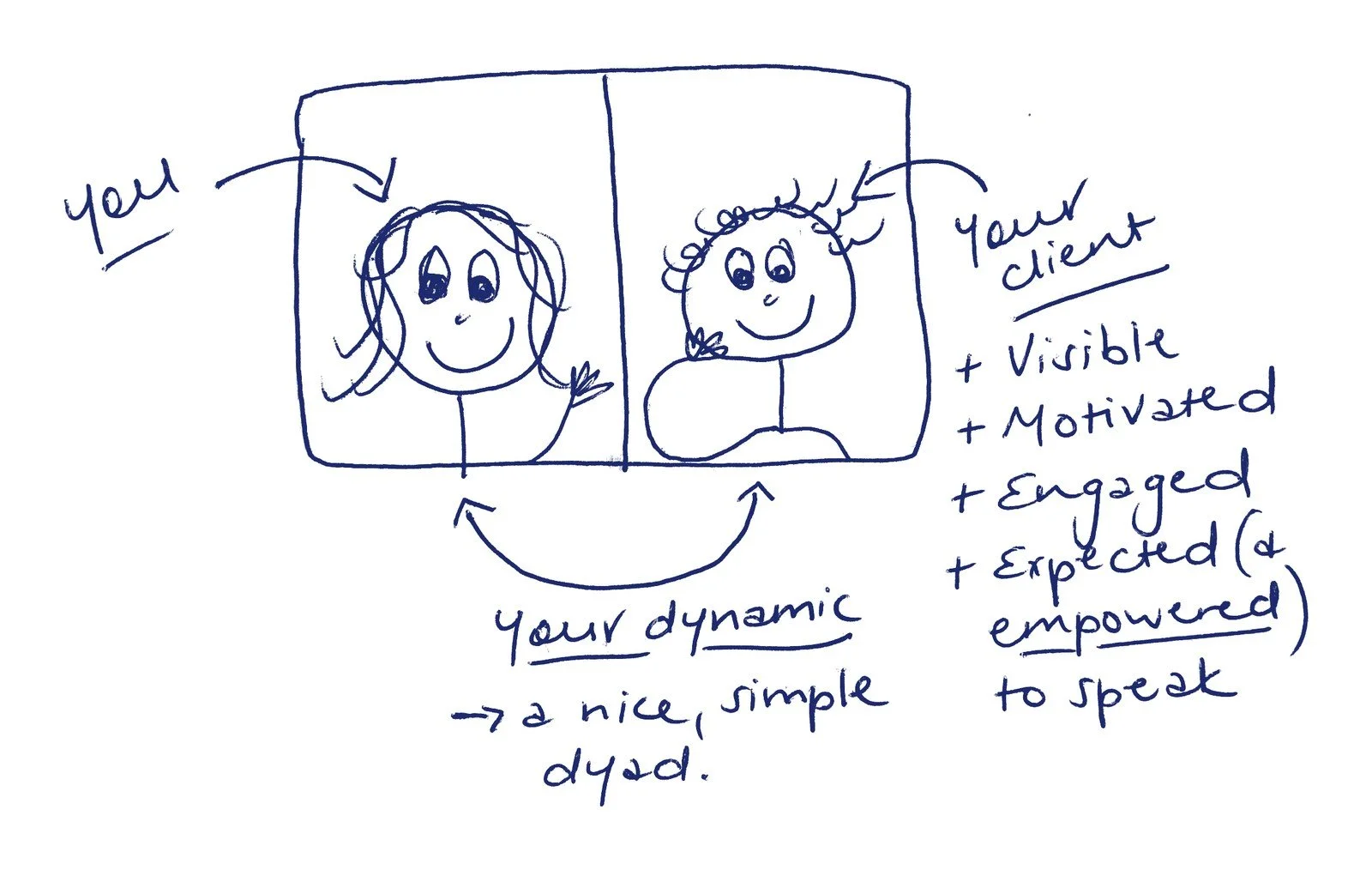
Because there are only two of you in the room, things are pretty easy to manage. You know if their attention drifts, a concept doesn’t land, or the conversation isn’t going anywhere meaningful.
This is you in a zoom room with a group of clients or prospects:
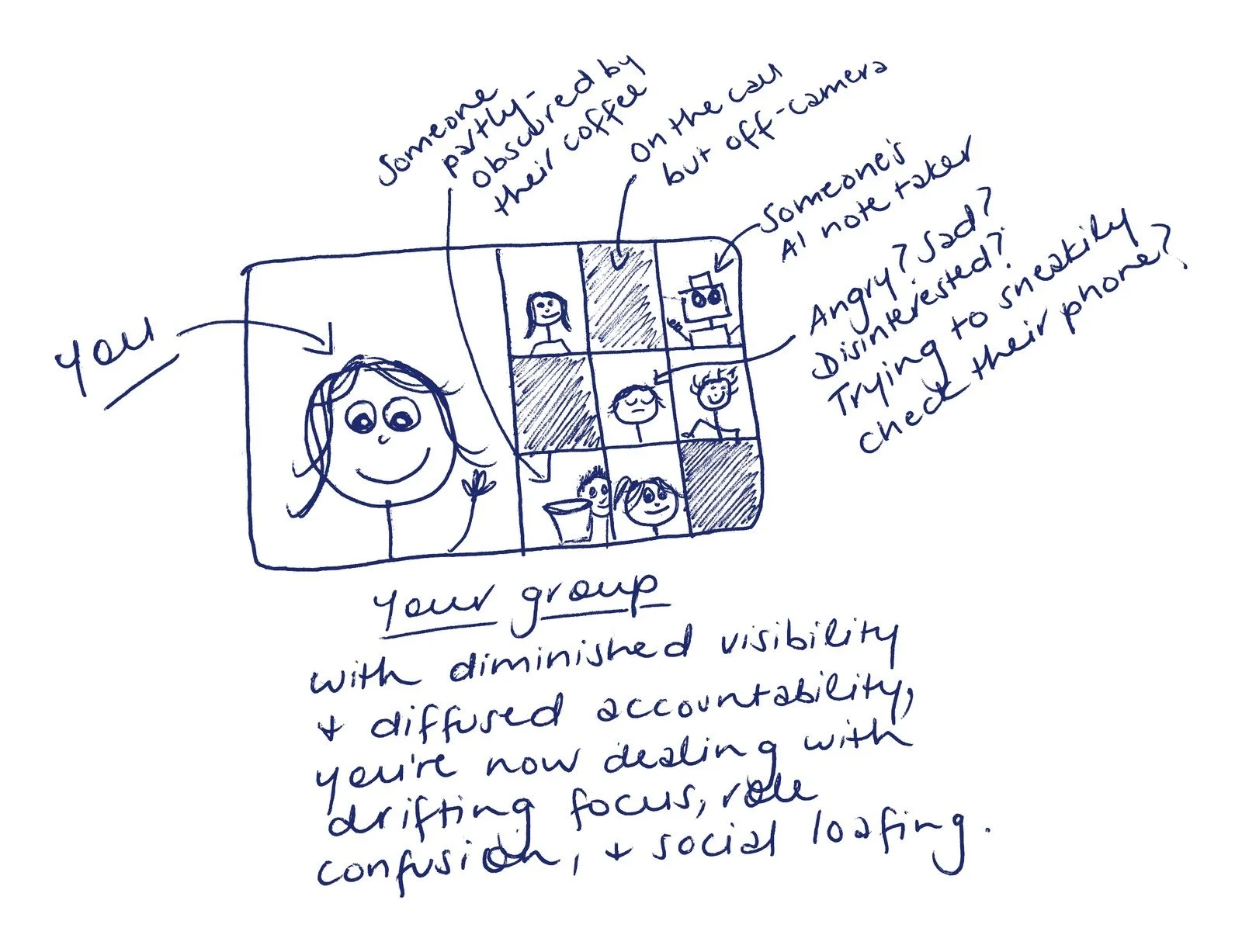
Oh, and did I mention that since there are 10 of you on the call, you now have at least 46 dynamics to manage? (Yup, these bad boys snowball with every additional person in the room).
That’s 45 possible dyads, as well as the whole group dynamic, and almost certainly some smaller factions — those two people hitting it off in the chat, or the group of regulars who have banded together, or the people with vastly different viewpoints who are starting to rub each other the wrong way (these dynamics can all help or hinder, by the way — it depends on how you manage them).
Plus, everybody in the room is looking to you for cues on how to behave in the space.
🤔 How are they meant to engage — with you and each other?
🤔 What happens if there’s an awkward silence, or something doesn’t land?
🤔 How do you respond when someone asks a question (and does your response make it feel safe and rewarding enough for them to bring their stuff to the table)?
So, yeah… that’s why the room feels heavy.

Since there are approximately 27,357 resources that help with the offers, automations, and marketing for 1:many offers (courses, coaching, containers, memberships, masterminds, and the like), but almost none that teach the facilitation side of things…
Most of us learned to facilitate by doing it over and over and hoping it got better
‘Maybe if I just find the right icebreaker… or the perfect format for my slides?’ 😬
But a room that creates meaningful opportunities —
Aha moments, points of connection, reduced feelings of ‘aloneness’, momentum, and out-of-the-room implementation (just to name a few) —
Is a result of skills and strategies that are 100% learnable.
Which is exactly what this email series is here to show you.
Over six days you'll learn how to:
→ Increase the chances people actually show up in the first place, because the dynamics of your room start long before anyone clicks "join"
→ Open with a question people will happily — and quickly! — answer (think: no long-winded intros, performative shares, or bits of intel that go nowhere)
→ Turn awkward silence or polite banter into meaningful engagement — and norm the behaviours you want to see as you go
→ Manage a dominant voice, Goldilocks style — think: not too soft (i.e. the approach that allows you and your agenda to get steamrolled), not too harsh (i.e. the approach that fractures the room), but juuuuust right 👌🏻
→ Get members talking to each other, not just to you, so you stop being the bottleneck in your own space (psst… if you’ve ever found yourself in the very awkward and relatable situation of offering 1:1 support and a 1:many price point, this is for you)
→ Name the elephant in the room — the thing everyone’s noticed and nobody’s mentioned, so you can create opportunities for self-awareness, real-time learning, and increased cohesion in the group
Shall we get started?

A few snippets from people who’ve learned this stuff from me
-
![]()
“It was so flipping fun and easy to make small changes that rippled into major differences. Increased show up rates to live calls, increased engagement in asynchronous support, more structure on live calls without stifling the life of the group… people are clamouring to participate.”
- CAROLYN ROBISTOW, GROUP PROGRAM COACH FOR THERAPISTS -
![]()
"I was a fairly confident facilitator beforehand, but now I feel like I have more skills. I know what those skills are called, and it has also reminded me of some of them and encouraged me to touch back on those."
- DR MICHELLE MAZUR, MESSAGING STRATEGIST, AUTHOR AND TEDX SPEAKER
-
![]()
“I just feel like I'm better equipped to make decisions about how to be a better facilitator. I’m already using some of my facilitation skills. The program hasn’t started yet, but in my Facebook group I did things a little differently and the response has been much better!"
-BRENNA MCGOWAN, PRE-LAUNCH STRATEGIST




Hi, by the way —
I'm Kirsty.
I'm an ex-psychotherapist and ex-launch copywriter, and I've been facilitating groups since way back in 2011—
Everything from legit group therapy to university classes (on campus and online), in-person retreats, and online programs.
Since 2018, I've helped online business owners design (and redesign) the group spaces they run, and the concepts in these emails are the things I find myself going back to over and over again when I explain what's happening — or not happening — in someone's room.
I hope they help you just as much as they’ve helped my clients 🫶🏻